

The Future of Contact Centers is not AI
Artificial Intelligence isn't eliminating contact centers; it's eliminating simple interactions.
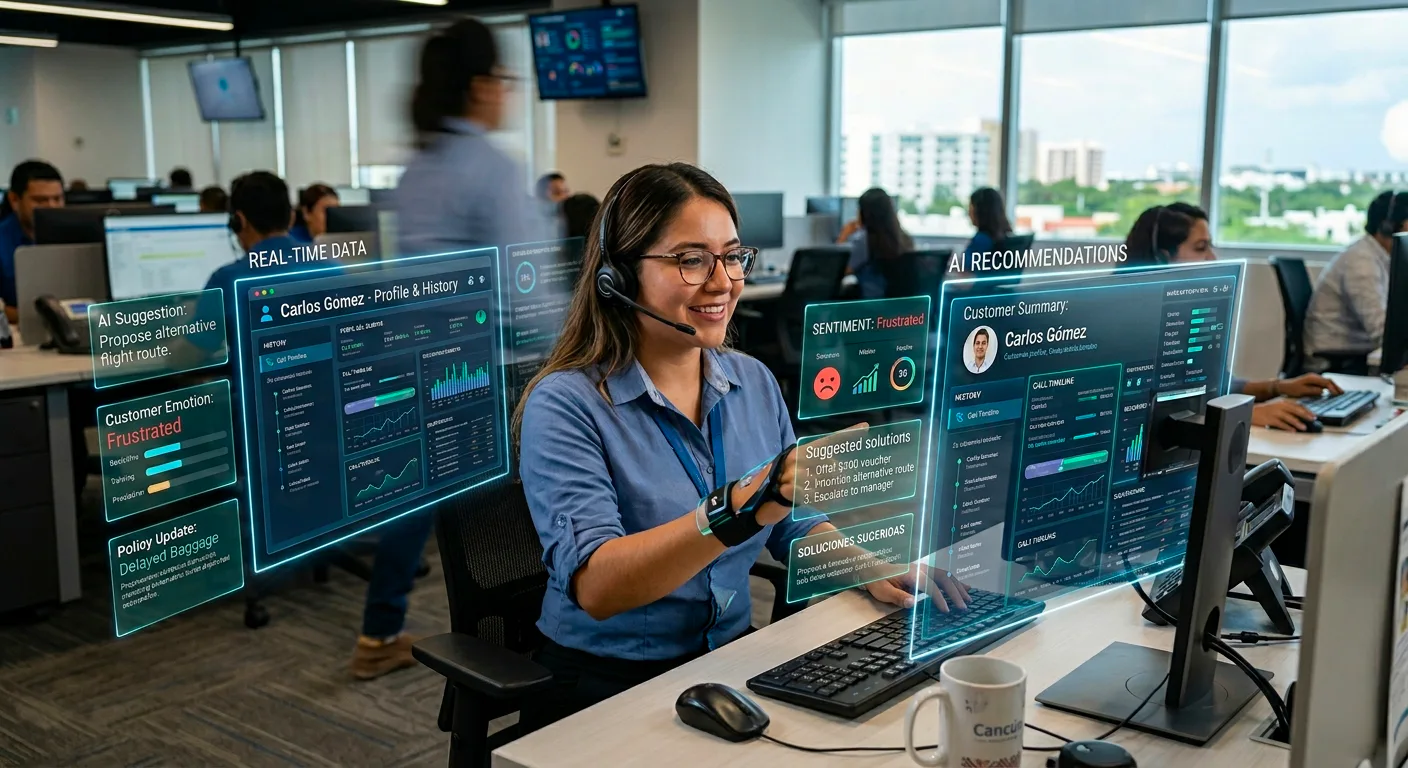
The Future of the Contact Center Isn't AI. It's Augmented Humans.
Artificial Intelligence isn't eliminating contact centers; it's eliminating simple interactions. For years, the Customer Experience industry debated the future as a binary scenario: total automation versus traditional support models. But operational reality is proving something very different.
Today, when a customer decides to pick up the phone, it's rarely to check a balance or track an order. Those types of tasks have already been absorbed by apps, webchats, and virtual assistants.
The calls reaching a human agent now represent something far more complex: frustration, urgency, uncertainty, or situations requiring judgment, empathy, and real problem-solving ability.
And that is where the real challenge for the industry begins.
The Automation Paradox
As virtual assistants and automation platforms filter out transactional inquiries, interactions that escalate to voice become more emotionally intense and operationally critical.
However, many organizations continue to operate under a model designed for another era—agents navigating multiple screens, searching for information in static knowledge bases, and spending several minutes on After Call Work (ACW) following every interaction.
Demanding that an agent resolve high-complexity conversations while dealing with constant operational friction not only degrades the customer experience; it also accelerates internal burnout. AI eliminates that friction around the agent.
The Rise of the Augmented Agent
At Wepartner, we believe technology should work for the agent, not the other way around. That is why the evolution of the operating model involves integrating next-generation cloud platforms, AI copilots, and real-time operational connectivity tools that reduce administrative burden and accelerate case resolution.
The result is a new operational profile: the Augmented Agent.
An agent capable of operating with real-time contextual assistance, intelligent automation, and immediate visibility into the information needed to resolve complex interactions with greater speed and precision.
How AI Is Transforming Operations in Real Time
When AI is properly implemented within a CX ecosystem, its impact goes far beyond automation. It completely transforms the agent's operational experience.
-
Live contextual assistance
AI tools can analyze the reason for contact while the conversation is happening and suggest answers, policies, or next steps in real time. This reduces search times and enables much smoother, more natural conversations. -
Reduction of After Call Work (ACW)
Intelligent copilots can automatically generate summaries, categorize tickets, and update the CRM immediately upon wrapping up an interaction, resulting in less administrative load and higher operational availability. -
More room for empathy
When agents no longer focus on mechanical tasks, they can concentrate on what truly matters: listening, connecting emotionally, and resolving issues with human judgment. Empathy cannot be automated, but it can be amplified.
The New CX Talent Profile
This transformation also redefines the talent profile within a modern BPO. The CX of the future will no longer rely on agents trained solely to follow rigid scripts or memorize static processes. Now, value lies in profiles with emotional intelligence, critical thinking, technological adaptability, and the ability to collaborate with AI tools in real time.
The key differentiator is now who resolves better.
The Real Competitive Advantage
Technology is becoming increasingly democratized. Copilots, automations, and intelligent platforms will eventually be available to everyone. The true competitive advantage won't be having AI; it will be knowing how to orchestrate it correctly within a human operation.
Optimizing customer experience doesn't mean choosing between people or technology. It means building models where AI absorbs operational friction and human talent multiplies the value of every interaction.
The future of CX doesn't belong to machines.
It belongs to the humans empowered by them.